If Greenland, the world’s largest island, were a state in the United States, it would send two Democrats to the U.S. Senate, given how left-leaning it is. Because it is poorer than the United States, absorbing Greenland would be costly. The poorest U.S. states receive more money from the federal government than their citizens pay in taxes. Greenland has high rates of alcohol abuse and domestic violence. It’s a cold, barren wasteland.
Yet the New York Times notes that President Trump “seems increasingly fixated on the idea that the United States should take over” Greenland, a “gigantic icebound island, with one official saying the president wants to buy it and another suggesting that the United States could simply take it. Just a few days ago, Mr. Trump said: ‘We need Greenland from the standpoint of national security.'”
But why do we need to take it from our Danish allies? Right now, Greenland is a self-governing territory that is technically part of Denmark. Denmark is America’s NATO ally, and 43 Danish soldiers died fighting on America’s side in Afghanistan.
As the New York Times notes,
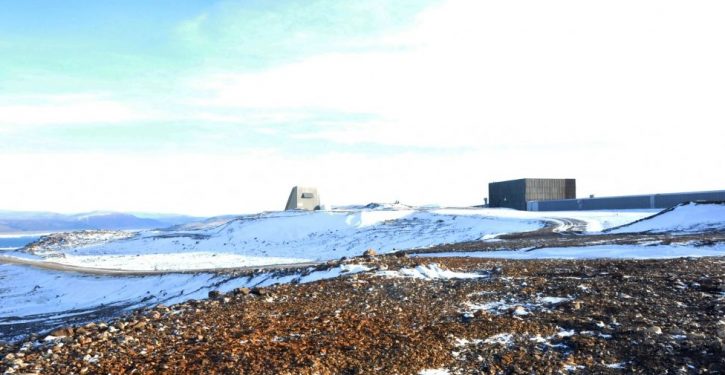
Under a little-known Cold War agreement, the United States already enjoys sweeping military access in Greenland. Right now, the United States has one base in a very remote corner of the island. But the agreement allows it to “construct, install, maintain, and operate” military bases across Greenland, “house personnel” and “control landings, takeoffs, anchorages, moorings, movements, and operation of ships, aircraft, and waterborne craft.”
It was signed in 1951 by the United States and Denmark, which colonized Greenland more than 300 years ago and still controls some of its affairs.
“The U.S. has such a free hand in Greenland that it can pretty much do what it wants,” said Mikkel Runge Olesen, a researcher at the Danish Institute for International Studies in Copenhagen.
“I have a very hard time seeing that the U.S. couldn’t get pretty much everything it wanted,” he said, adding, “if it just asked nicely.”
Similarly, Dan Gardner says, “what does the US need or want that Denmark denies? The US had DOZENS of bases on Greenland; it chose to reduce them to one. If the US asked for more bases, or whatever, Denmark would say yes, as it always has.”
Conservative Danish parliamentarian Rasmus Jarlov says, “The USA already has a defence agreement with Denmark that gives them exclusive and full military access to Greenland. But they are not using it. They have downgraded their presence by 99%.”
Greenland does have minerals, but only a small fraction of them are economically viable to mine. Greenland is too cold and icy a place to mine most of those minerals when mining is easier in more temperate climates. Moreover, “analysts say, the United States doesn’t need to take over the island to get” its minerals. “Greenlanders have said they are open to doing business — with just about anyone.” Australians, Canadians, and other foreigners are already involved in mining in Greenland.
As a hedge fund investor notes, Greeland’s minerals are mostly inaccessible:
People are hallucinating on Greenland’s mineral wealth. Exploring and mining in the Arctic is a literal hellscape. The constraints are insane and the costs to overcome ’em are way past imagination.
Geologically, permafrost is a nightmare. Ground’s frozen solid—normal drilling hits a wall. Building stable foundations for gear is a massive money pit. Operations are cooked too.
Constant darkness for months in winter. Working 24/7 under floodlights craters efficiency and spikes accident risk. At -40°C to -50°C, metal gets brittle and just snaps.
You need custom alloy gear, and keeping fuel/lube from freezing is a constant battle. The diesel/power burn just to keep lights on and engines warm is eye-watering. Immediate Opex blow-up. Logistics? Absolute disaster. It’s not about digging it out; it’s about moving it.
Zero roads or rails. Everything moves by heli, light plane, or ship. Moving ore to a port costs multiples of what normal mines pay. Plus, zero local smelters.
You gotta ship it across oceans, burning time and cash. Shipping windows are tiny. Some coasts are only accessible a few months a year. You either pay for icebreakers or pray the 1-year supply/export window doesn’t get wrecked by bad weather. If the ship misses the slot, the whole year is a wash. Look at the Citronen Fjord Zn project at 83°N. It’s one of the world’s biggest undeveloped Zn-Pb deposits, but it’s 2,100km north of Nuuk. Total isolation. They get a 3-month window to move a year’s worth of cargo.
One bad storm and the project is bricked for the season. Ironbark Zinc tried for ages, but it just got flipped to Dubai-based Almeera Ventures. That’s a clear signal on how brutal the Capex and funding hurdles are.
The core issue: does the margin even justify the risk? Building a mine w/ zero infra is a Capex black hole. Think global warming helps? Think again. Thawing permafrost is actually trashing existing infra and roads. Extreme weather just jacks up Opex even more. We’re talking 10-15 years from discovery to first ore. If commodity prices crater in between, you’re left holding a stranded asset. This is the reality of mining. Arctic development is 10x harder than you think. Please, stop living in a dream world. There’s a reason Denmark wasn’t aggressive on development.
You really think they held back just to protect the Inuit? Give me a break. Money always trumps ESG in the end, no matter the optics. You can spam ‘self-sufficiency’ and ‘strategy’ all you want, but you can’t meme your way past physics and economics. Wake up.
Running Greenland costs money. Denmark recently helped finance three new airports in Greenland costing $800 million. It has spent billions and billions of dollars on Greenland, for little in return.
Greenland is mostly covered by ice and has fewer than 57,000 people. Most of Greenland is uninhabitable because it is covered by a massive ice sheet. Obviously, Denmark is not going to build thousands of miles of roads to serve a tiny number of people, when it is faster to travel by airplane across the vast ice sheet. Instead, Denmark has spent generously on ports and airports Greenlanders can use.
Greenlanders are coddled by Denmark’s progressive government, which subsidizes their lifestyle. It is Danish money that props up Greenlanders’ middle-class standard of living. Without Danish aid, Greenland would be much poorer due to its remote location and hostile and unforgiving climate, which make it almost impossible to farm or operate many kinds of industry.
The uncle of a Liberty Unyielding blogger, who took an interest in Greenland, made the mistake of going there on a trip, and discovered how little Greenland had to offer, and what drunken welfare recipients many of them are:
Jackie and I went to Greenland on the eastern part of the island. Most of the people live on the western part of the island. The part that we visited was really harsh and inhospitable. Everybody in the two towns we visited depended upon the welfare checks they got each month from the government … They would then get drunk and the kids would not go to school. My guess is that a good amount of their income also came from tourism. There had been a US Air Force radar site on the hills inland from the village where we stayed. We were only there for three days. Not much to do there, except hike in the local areas and look at the sled dogs. The dogs were not friendly. The dogs spent all their time outside in the cold.
Trump’s fixation with Greenland could cost the U.S. billions of dollars in export sales, because Denmark’s government may buy fewer high-tech weapons from the U.S. due to Denmark’s deteriorating relations with America as a result of Trump’s designs on Greenland.
“We must avoid American weapons if at all possible,” said the chairman of Denmark’s parliamentary defense committee last year. He said he regrets choosing America’s F-35 fighter aircraft for his country, citing the possibility that the U.S. may cut off support for the fighter in order to seize Greenland. “As one of the decision-makers behind Denmark’s purchase of F-35s, I regret it,” said Rasmus Jarlov, a member of parliament for Denmark’s Conservative People’s Party.
Jarlov was responding to rumors that the Lockheed Martin F-35 Lightning II may have a “kill-switch” that allows the U.S. government to remotely disable F-35s bought by U.S. allies. On March 18, the Pentagon denied that the stealth fighter has such a kill-switch.
But the Danish official was not convinced. “We obviously cannot take your word for it,” Jarlov said:
He added that the US could scupper Copenhagen’s use of the F-35 just by stopping the supply of spare parts — a similar dilemma that Ukraine faced when Washington temporarily paused military aid.
“I can easily imagine a situation where the USA will demand Greenland from Denmark and will threaten to deactivate our weapons and let Russia attack us when we refuse,” wrote Jarlov, who is also his party’s spokesperson for his stance on Greenland’s affairs….”Therefore, buying American weapons is a security risk that we cannot run. We will make enormous investments in air defense, fighter jets, artillery, and other weapons in the coming years, and we must avoid American weapons if at all possible,” he said.
“I encourage our friends and allies to do the same,” Jarlov added.
Denmark announced in 2016 that it was spending about $3 billion on 27 F-35s to replace its aging fleet of F-16 Fighting Falcons. Jarlov was serving as Denmark’s defense committee chairman at the time.
85% of Greenlanders oppose becoming part of the United States.