
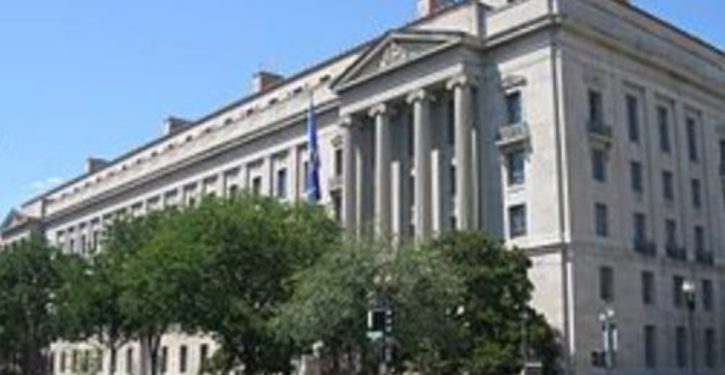
On December 9, the Justice Department repealed its harmful Title VI “disparate impact” regulations. Since their adoption in 1973, those regulations had caused billions of dollars in damage to America’s economy by interfering with merit-based selection processes. The “disparate impact” regulations pressured countless institutions to drop merit-based selection requirements (such as standardized tests) and colorblind disciplinary policies. They also led some institutions to adopt racial quotas to offset racial imbalances that were not caused by racism.
Title VI is a law banning racial discrimination by recipients of federal funds, such as school districts, universities, and healthcare providers who accept Medicare payments.
Yet the Title VI “disparate impact” regulations did not target racism. Under a “disparate impact” regulation, an institution can be liable for “neutral”, “evenhanded” application of its rules, just because more minorities violate those rules, unless those rules are proven to be necessary to meet an important goal. The institution can be held liable for “disparate impact” even if everyone concedes that it had no discriminatory intent at all, and did not treat a black person differently than a similarly situated white person. Institutions could spend millions of dollars on consultants to try to demonstrate the necessity of a standardized test, only to have civil rights officials rule that the test wasn’t essential enough to use and had to be discarded because more blacks failed the test than whites (the higher failure rate is considered “disparate impact”).
The Title VI “disparate impact” regulations were legally invalid to begin with, as the Supreme Court suggested in its decision in Alexander v. Sandoval, 532 U.S. 275, 286 n.6 (2001). The Supreme Court ruled in that case that Title VI only bans “intentional discrimination,” not disparate impact, and it called the government’s defense of federal Title VI disparate regulations “strange” in footnote 6 of its ruling. As the Supreme Court explained, “We cannot help observing, however, how strange it is to say that disparate-impact regulations” are valid applications of Title VI, when Title VI “permits the very behavior that the regulations forbid…..’If, as five Members of the Court concluded in Bakke, the purpose of Title VI is to proscribe only purposeful discrimination … , regulations that would proscribe conduct by the recipient having only a discriminatory effect … do not simply “further” the purpose of Title VI; they go well beyond that purpose.’”
The Supreme Court has also ruled that racially “disparate impact” does not violate the Constitution, in Washington v. Davis (1976). As it noted, a vast range of perfectly normal policies and practices have a racially disparate impact.
On the other hand, a different federal law — Title VII, as opposed to Title VI — does ban certain types of racially disparate impact, under the 1991 Civil Rights Act. (Title VI only applies to recipients of federal funds, such as universities and doctors who accept Medicare payments. Title VII covers most workplaces. Unfortunately, the Justice Department cannot change Title VII, but it can repeal its Title VI disparate-impact regulations, because they are not required by the Title VI statute, which does not ban disparate impact.).
The Justice Department explained its repeal of the disparate-impact regulations in a December 9 press release:
Today, the Justice Department issued a final rule updating its regulations under Title VI of the Civil Rights of 1964. This rule ensures that our nation’s federal civil rights laws are firmly grounded in the principle of equal treatment under the law by eliminating disparate-impact liability from its Title VI regulations.
“For decades, the Justice Department has used disparate-impact liability to undermine the constitutional principle that all Americans must be treated equally under the law,” said Attorney General Pamela Bondi. “No longer. This Department of Justice is eliminating its regulations that for far too long required recipients of federal funding to make decisions based on race.”
“The prior ‘disparate impact’ regulations encouraged people to file lawsuits challenging racially neutral policies, without evidence of intentional discrimination,” said Assistant Attorney General Harmeet K. Dhillon of the Justice Department’s Civil Rights Division. “Our rejection of this theory will restore true equality under the law by requiring proof of actual discrimination, rather than enforcing race- or sex-based quotas or assumptions.”
“For over 50 years, the prior disparate-impact rule fostered the very thing the Civil Rights Act of 1964 prohibited — discrimination on the basis of race, color, or national origin. But with today’s rule,” said Chief of Staff and Supervisory Official for the Office of Legal Policy Nicholas Schilling. “The Department reaffirms Congress’ commitment to measure all Americans by merit.”
Congress enacted Title VI, 42 U.S.C. § 2000d, as part of the landmark Civil Rights Act of 1964. It prohibits discrimination on the basis of race, color, and national origin in programs and activities receiving Federal financial assistance. In 1973, the federal government added to the law a new rule — disparate impact — that was not part of the law. The term “disparate impact” refers to the concept of imposing liability on a federal fund recipient only because there may be different outcomes for different people, not based on prejudice or intent. That prior disparate-impact rule was already enjoined in one state, prohibiting DOJ from enforcing it there.
The Department’s new rule reflects the best reading of Title VI, as the Supreme Court has repeatedly recognized for over twenty years. Title VI has and will continue to prohibit intentional discrimination. The Department’s new rule ensures that recipients of federal funding will be judged on their actual conduct, not on statistical outcomes or circumstances beyond their control.
Despite decades of case law, the Department’s prior Title VI disparate-impact regulations remained on the books, sowing confusion and creating costly compliance obligations for states, local governments, nonprofits, and private organizations receiving federal financial assistance. This new rule eliminates these burdens, promotes consistent enforcement across agencies, and restores public confidence in civil rights law by aligning the Department’s regulations with the Constitution.