
“The Massachusetts Institute of Technology recently announced plans to close two of its five libraries to address a $300 million budget gap, blaming it partly on actions by the Trump administration,” reports The College Fix:
The budget cuts also include library staff and the purchases of print books and journal subscriptions…
MIT spokesperson Kimberly Allen said reasons for the cuts include the new 8 percent tax on university endowments, which President Donald Trump signed into law over the summer…She also attributed the shortfall in part to the federal government’s cuts to scientific research…
The budget cuts, announced on the MIT Libraries website Nov. 19, include the closures of the Dewey and Barker libraries in June 2026.
“Items from the Barker and Dewey collections will remain fully accessible by request, with pickup and delivery options available,” the announcement states.
The institution also plans to cut staff at a third location, the Rotch Library, in 2027.
Fewer and fewer students are using library books, the Boston Globe says:
Print collections at the university are used far less than they were even a decade ago, making up less than 1 percent of the total library use and foot traffic in most campus libraries, a spokesperson confirmed.
“I believe these decisions represent the most strategic path to preserving the MIT Libraries for our full community,” said director of libraries Chris Bourg in a statement. “They are in keeping with our commitment to being a digital-first library and will help ensure that we remain an innovative library system, strategically aligned with MIT, in the years to come.”
MIT has a $27.4 billion endowment, which grew 14.8 percent last year.
MIT pays the highest endowment tax rate under the recently-passed federal law. The endowment tax rate rises from 1.4 percent to 8 percent, as college endowment per capita rises.
The University of Chicago has bigger structural financial problems than MIT.
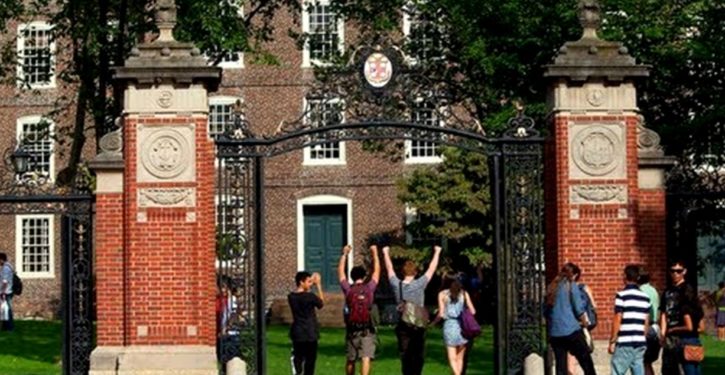
Unionization and bureaucratic bloat have led to a budget deficit at Brown University, despite its huge tuition and wealth. Brown University cited “staff growth outpacing growth in faculty” as a contributing factor. Growing bureaucracy is a common problem in American universities. Harvard University has 2,600 more college staff than it has undergraduate students.
Harvard alumni such as former Massachusetts ACLU leader Harvey Silverglate have argued that the growth in college bureaucracies chokes off free speech and results in college rules micromanaging student life and killing off fraternities and other voluntary institutions. Silverglate recently ran an unsuccessful campaign to be elected to Harvard’s Board of Overseers to curb administrative bloat. His platform included a proposal to “dismiss 95 percent of the bureaucrats.” “Having so many administrators…adversely affects the academic culture…Administrators, with little useful work to do, enact speech codes, with the codes enforced by ‘kangaroo courts’ composed mostly of administrators. These administrators have no idea what academic freedom is, much less due process,” he said.
Harvard employs dozens of full-time administrators and staff in diversity, equity and inclusion positions, both at the university level and in each of its schools. A study by a California State University professor found that an increase in “diversity, equity and inclusion” policies at a college is linked to rising opposition there to free speech. “The rise of DEI bureaucracies has actually coincided with the beginning of a ‘Free-Speech Crisis on College Campuses,’” noted the study.
College DEI staffers encourage illegal discrimination against whites and Asians. For example, at the University of California at Los Angeles, the Director of Race and Equity advocated denying white employees leave because of their race. That director, Johnathan Perkins, also claimed that “every white person is racist to some degree”, and falsely claimed that “white people cannot be victims of racism,” and “only white people can impose racist harm.” These claims disregarded court rulings finding that whites can be victims of racism and nonwhites can act illegally in committing racist acts. Perkins tells whites not to wish him a “Happy Juneteenth” because he will “flip tf out” if they do. He reacted to the death of England’s Queen Elizabeth by saying,“Good riddance.”
Harvard is not unique in having a large and costly bureaucracy devoted to diversity and equity. By 2011, there were already more college administrators than faculty at California State University, many of them devoted to diversity and equity. And the University of California, which claimed to have cut administrative spending “to the bone,” was busy creating new positions for politically-correct bureaucrats even as it raised student fees and tuition. As the Manhattan Institute’s Heather Mac Donald noted in 2011:
The University of California at San Diego, for example, is creating a new full-time “vice chancellor for equity, diversity, and inclusion.” This position would augment UC San Diego’s already massive diversity apparatus, which includes the Chancellor’s Diversity Office, the associate vice chancellor for faculty equity, the assistant vice chancellor for diversity, the faculty equity advisors, the graduate diversity coordinators, the staff diversity liaison, the undergraduate student diversity liaison, the graduate student diversity liaison, the chief diversity officer, the director of development for diversity initiatives, the Office of Academic Diversity and Equal Opportunity, the Committee on Gender Identity and Sexual Orientation Issues, the Committee on the Status of Women, the Campus Council on Climate, Culture and Inclusion, the Diversity Council, and the directors of the Cross-Cultural Center, the Lesbian Gay Bisexual Transgender Resource Center, and the Women’s Center.