A bill introduced in Virginia could lead to the release of dangerous murderers who committed their crime as teenagers. If passed, SB60 would mandate that the Virginia Parole “Board shall not deny parole for a juvenile offender based on factors outside of his demonstrated ability to change, such as the nature of the offense or any effects resulting from the commission of such offense.”
An inmate’s dangerousness is sometimes shown by “the nature of the offense,” such as when the inmate is a serial killer, who killed again and again after previously being released from incarceration. Consider Kenneth McDuff, the “broomstick killer.” At the age of 19, after being paroled, McDuff and an accomplice kidnapped three teenagers. He shot and killed two boys, then killed a girl after raping her and torturing her with burns and a broomstick. Later, after being paroled yet again, he murdered additional women — as many as 15 women in several different states.
To keep such killings from happening, a parole board needs to take into account “the nature of the offense” as one of many factors, in order to avoid releasing such dangerous inmates. But SB60 would keep parole boards from considering that as a factor in their decision in deciding not to release an inmate. The serious nature of the offense doesn’t always justify keeping an inmate in prison. If an inmate killed one person in a rage, he may reform while in prison, and some day deserve to be released based on good behavior. But a serial killer’s deep-seated compulsion to kill people can be a good reason to deny him parole, even if he lacks the “ability to change” that propensity.
SB60 says that the Parole “Board shall not deny parole for a juvenile offender based on factors outside of his demonstrated ability to change.” (emphasis added).
So even if a factor indicates the offender is dangerous, the Parole Board can’t consider it unless it can demonstrate that the offender had the ability to change it. If the offender suffers from compulsions, cravings, or addictions that make it hard for him to be obedient or follow the rules while in prison, the Parole Board may be precluded from considering his disobedience, if it can’t “demonstrate” that he had the ability to behave better. That’s true even if such disobedience is predictive of returning to a life of crime if released.
Juvenile offenders spend years in prison before being eligible for parole, so SB60’s sponsor, Senator Mamie Locke, may assume that such offenders have aged out of crime. But some inmates don’t age out of crime.
Most inmates commit more crimes after being released, even when they have already served over ten years in prison. 57.5% of federal inmates imprisoned for violence for ten years or more were arrested yet again after being released, according to a 2022 report from the U.S. Sentencing Commission. (See Recidivism of Federal Violent Offenders Released in 2010, pg. 33 (Feb. 2022)).
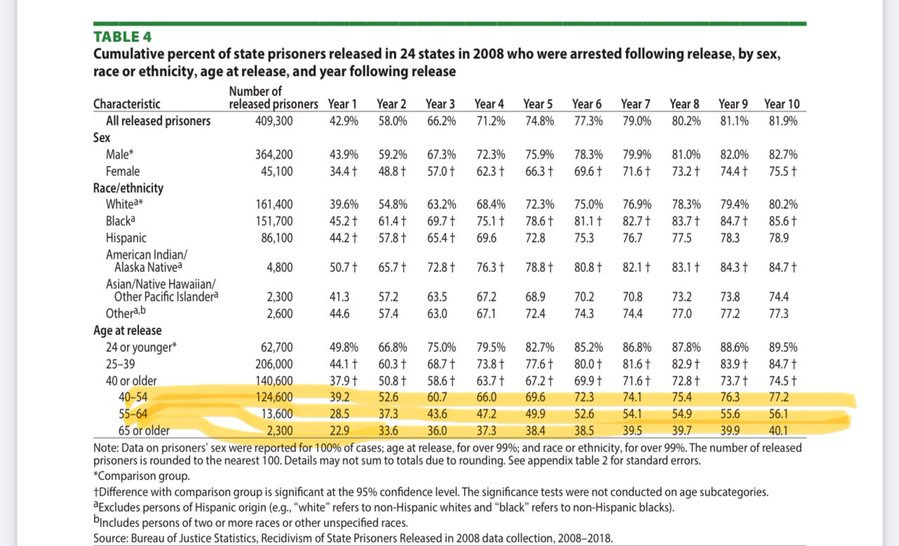
Even if juvenile inmates reach the age of 40 before being paroled, they could still be dangerous. Nationally, 81.9% of all state prisoners released in 2008 were subsequently arrested within a decade, including 74.5% of those 40 or older at the time of their release. (See Bureau of Justice Statistics, Recidivism of Prisoners in 24 States Released in 2008: A 10-Year Follow-Up Period (2008-2018), pg. 4, Table 4)).
Even among inmates released at age 55 or over, some return to a life of crime. Of state prisoners released in 2008, 56.1% of those age 55 or over at the time of their release were subsequently arrested by 2018, as were 40.1% of those age 65 or over. (See Bureau of Justice Statistics, Recidivism of Prisoners in 24 States Released in 2008: A 10-Year Follow-Up Period (2008-2018), pg. 4, Table 4)).
These arrest figures understate the crime rate among released inmates, because most crimes never even lead to an arrest. The fact that a crime occurs does not necessarily mean that the perpetrator can be identified, or that the crime will be reported even if the perpetrator is known.
As the FBI noted in Crime in the United States,
- In the nation in 2019, 45.5 percent of violent crimes and 17.2 percent of property crimes were cleared by arrest or exceptional means.
- When considering clearances of violent crimes, 61.4 percent of murder offenses, 52.3 percent of aggravated assault offenses, 32.9 percent of rape offenses, and 30.5 percent of robbery offenses were cleared.
- Among property crimes, 18.4 percent of larceny-theft offenses, 14.1 percent of burglary offenses, and 13.8 percent of motor vehicle theft offenses were cleared.
- In 2019, 23.8 percent of arson offenses were cleared by arrest or exceptional means.