
“Last year, more than 18,000 older people living with dementia left their homes and wandered off in Japan. Almost 500 were later found dead,” reports the BBC. “Police say such cases have doubled since 2012, underscoring a growing strain on the world’s oldest society. The crisis is further compounded by a shrinking workforce and tight limits on foreign workers coming in to provide care.”
The Japanese government is taking the problem seriously, after concluding that dementia-related medical and other costs will reach $90 billion by 2030, up from $57 billion in 2025.
Technology is already being used to cope:
Across the country, people are adopting GPS-based systems to keep track of those who wander.
Some regions offer wearable GPS tags that can alert authorities the moment a person leaves a designated area.
In some towns, convenience-store workers receive real-time notifications – a kind of community safety net that can locate a missing person within hours.
Other technologies aim to detect dementia earlier.
Fujitsu’s aiGait uses AI to analyse posture and walking patterns, picking up early signs of dementia – shuffling while walking, slower turns or difficulty standing – generating skeletal outlines clinicians can review during routine check-ups.
“Early detection of age-related diseases is key,” a Fujitsu spokesperson says. “If doctors can use motion-capture data, they can intervene earlier and help people remain active for longer.”
Scientists at Waseda University are developing AIREC, a 330 pound humanoid robot intended for use as a caregiver. “It can help a person put on socks, scramble eggs and fold laundry.” Scientists hope that in the future, AIREC will change diapers and prevent bedsores in patients.
Robots aren’t currently assisting most elderly people who live independently.
But robots are already caring for elderly people in nursing homes. “With around a third of its population over the age of 65, Japan is increasingly turning to robots to care for its elderly citizens. New research suggests that this isn’t as dystopian as it sounds. A working paper from the National Bureau of Economic Research, which surveyed robot adoption in Japanese nursing homes, found that the machines are associated with improvements in both the quality and productivity of elder care,” says the Cato Institute. Robots improve care in the nursing homes, and also improve the productivity of the humans working in them.
Other countries may need to use robots, too. Japan’s birth rate used to be among the world’s lowest, but by 2022, many nations had lower birth rates than Japan, or similarly-low birth rates. In 2023, the average Canadian woman was expected to have only 1.26 children, almost as low as Japan’s 1.20 children per woman.
South Korea’s birth rate has plunged to a shockingly-low level, with the average woman expected to have only 0.72 children in her lifetime, as of 2022. In Taiwan, the average woman is expected to have only 0.87 children in her lifetime. So countries like South Korea and Taiwan will have shrinking, rapidly-aging populations, with ever fewer young people to tend the elderly than Japan a generation from now.
In China, the average woman is expected to have only 1.18 children in her lifetime, resulting in China’s population rapidly shrinking in the second half of the 21st century. Rates are almost as low in much of Europe: 1.24 kids per woman in Italy, 1.16 kids per woman in Spain, and 1.46 kids per woman in Germany, as of 2022. All these birth rates are expected to fall further as the 21st century progresses.
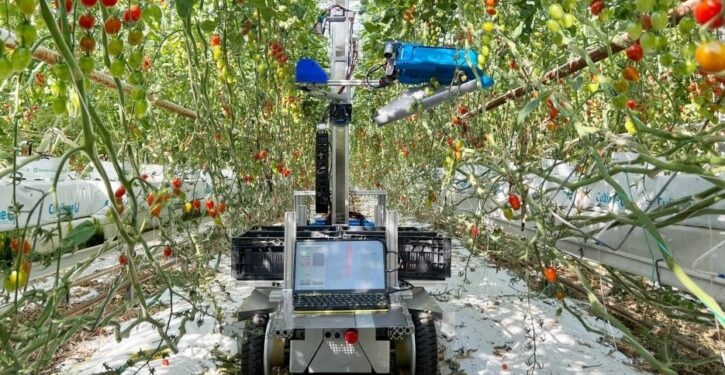
Robots with artificial intelligence are spreading on Japanese farms.
Robots replaced some fast-food workers after California increased the minimum wage for fast-food workers to $20 per hour, which many franchises just couldn’t afford.
In 2023, doctors used a surgical robot to carry out incredibly complicated spinal surgery.