
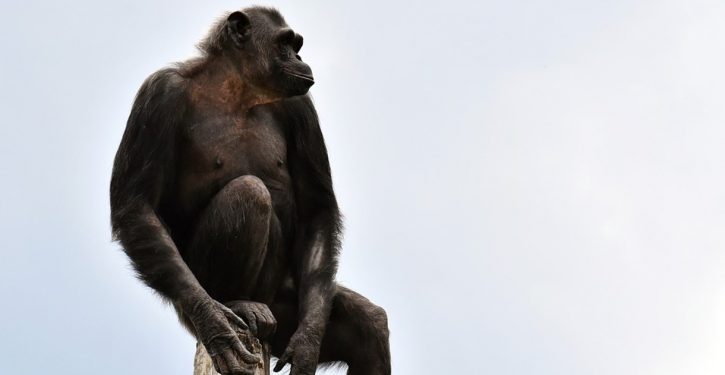
“An animal rights organization has asked the Michigan Supreme Court to hear its case that chimpanzees in an Upper Peninsula zoo deserve constitutional protection against unlawful imprisonment,” reports Michigan Public Radio:
The Nonhuman Rights Project, which has already lost twice in lower courts, argues that chimpanzees at the DeYoung Family Zoo in the Upper Peninsula deserve common law habeas corpus rights because they are highly intelligent, self-aware and genetically very similar to humans.
“So far, they have been denied the possibility of freedom based on one immutable fact about their biology: they are not human—although they share close to 99% of our DNA,” said the application filed this week. “Whether this arbitrary denial of liberty is tolerable under Michigan common law now confronts this Court.”
The Michigan Court of Appeals ruled in October that the chimpanzees are not human and so do not have constitutional protections.
The Nonhuman Rights Project’s goal is to have the chimpanzees moved to a preserve with conditions closer to their natural habitat.
Federal appeals courts have rejected similar lawsuits, finding that animals don’t have standing to sue, and that animal-rights groups generally lack standing to sue on their behalf. “The world’s whales, porpoises and dolphins have no standing to sue President Bush over the U.S. Navy’s use of sonar equipment that harms marine mammals, a federal appeals court ruled….A three-judge panel of the U.S. 9th Circuit Court of Appeals in San Francisco, widely considered one of the most liberal and activist in the country, said it saw no reason why animals should not be allowed to sue [emphasis added] but said they had not yet been granted that right.” (“Court Says Whales, Dolphins Cannot Sue Bush”, Reuters/PlanetArk, Oct. 21, 20004).
One problem with letting “animal rights” groups sue on behalf of animals is that they don’t always advocate for what is in the best interest of the animals, as opposed to their own ideological or financial interests. The late federal judge Andrew Kleinfeld said he had no conceptual problem with a gorilla having a right to sue, because some of his own human clients (criminal defendants) weren’t much smarter than a gorilla. But Judge Kleinfeld didn’t trust lefty NGOs who sued in animals’ behalf to faithfully represent the animals’ true interests. So he thought that even if a gorilla suffered an “injury in fact” in the eyes of the Constitution, it wasn’t clear that any such injury would be properly redressable, or that “prudential standing” would be present to justify a lawsuit.
On the other hand, the D.C. Circuit Court of Appeals allows animal rights groups to sue federal agencies based on trivial “informational injuries,” such as where an agency reduces animal inspections or regulatory disclosures in ways that result in the animal-rights group having less material for its press releases. Under that logic, even agency actions and policy changes that don’t result in death or injury to an animal can give rise to a lawsuit. (See People for the Ethical Treatment of Animals v. USDA, 797 F.3d 1087, 1093 (D.C. Cir. 2015)).