By John Loftus
While the administration wages war against alleged narco-terrorists in the Caribbean Sea, President Donald Trump has pledged to pardon a former head of state convicted of trafficking cocaine into the United States — an irony that beggars belief.
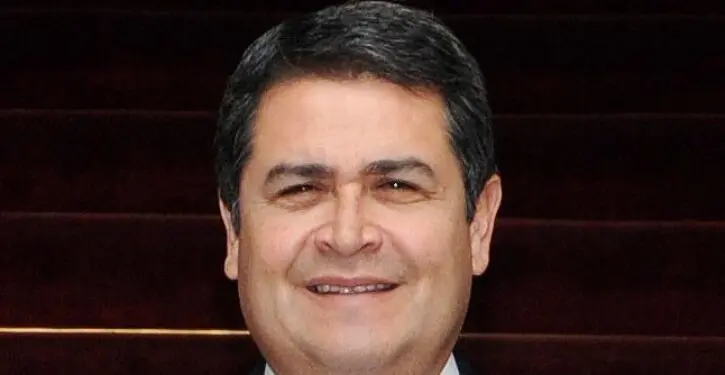
Trump announced Friday plans to pardon former Honduran President Juan Orlando Hernandez, who is currently serving a 45-year sentence for trafficking hundreds of tons of cocaine into the United States. Hernandez was convicted on drug trafficking and weapons charges in New York in 2024. He even once allegedly bragged, “We are going to stuff the drugs up the gringos’ noses, and they’re never even going to know it.” (Subscribe to MR. RIGHT, a free weekly newsletter about modern masculinity)
Trump told reporters Sunday that he was pardoning Hernandez because he was unfairly targeted by the Biden administration.
“Well, I was told — I was asked by Honduras, many of the people of Honduras, they said it was a Biden setup,” the president said aboard Air Force One. “He was the president of the country, and they basically said he was a drug dealer because he was the president of the country, and they said it was a Biden administration setup. And I looked at the facts, and I agreed with that.”

Honduras’ former President Juan Orlando Hernandez (2-R) is escorted by Minister of Security Ramon Sabillon (R) towards a plane of the US Drug Enforcement Agency (DEA), during his extradition to United States at the Air Force Base, in Tegucigalpa, on April 21, 2022. (Photo by ORLANDO SIERRA/AFP via Getty Images)
Something of note: the prosecution of Hernandez actually began under the first Trump administration, and concluded under Biden’s.
Trump also suggested on TruthSocial the day of the announcement that Hernandez was “treated very harshly and unfairly” by the Biden administration, according to many people” that the president “greatly respect[s].”
So, who might these “many people” be, and why would they lobby Trump to pardon Hernandez?
The answer may lie in Hernandez’s previous support for tech-friendly development laws that had the backing of several American investors with ties to the current Trump administration. (RELATED: The Trojan Horse That Snuck Through MAGA’s Gates)
In 2013, the Honduran government passed a law that allowed corporations to set up Zones for Employment and Economic Development, also known as ZEDEs, within the country. Inside these zones, entire for-profit city-states could be built with their own laws, regulations, schools, and police forces, according to a 2022 report from Rest of World, a nonprofit publication that focuses on global tech stories. ZEDEs were “heavily pushed” by Hernandez during his time in office as a means to spur economic development, Rest of World noted.

MIAMI, FLORIDA – APRIL 7: Peter Thiel, co-founder of PayPal, Palantir Technologies, and Founders Fund, gestures as he speaks during the Bitcoin 2022 Conference at Miami Beach Convention Center on April 7, 2022 in Miami, Florida. The worlds largest bitcoin conference runs from April 6-9, expecting over 30,000 people in attendance and over 7 million live stream viewers worldwide. (Photo by Marco Bello/Getty Images)
One such ZEDE city-state, Próspera, attracted global investors with the promise of a coastal libertarian haven that offered low taxes and regulations conducive to the cryptocurrency industry. The zone even made Bitcoin an official currency. Próspera’s financial backers included prominent figures such as Peter Thiel and Marc Andreessen, who were involved through Pronomos Capital, a venture capital fund that invests in projects aimed at creating autonomous cities.
Both Thiel and Andreessen have very close ties to the Trump administration, with Thiel having backed Vice President J.D. Vance’s Senate campaign in 2022. Andreessen has significantly benefited from his support of Trump’s campaign in 2025, and following the election, federal investigations targeting multiple companies backed by his venture capital firm, Andreessen Horowitz, were reportedly dropped. Palantir, a company Thiel co-founded, has drastically expanded its work with the Trump administration.
The Honduran National Congress eventually repealed the ZEDE law in April 2022 after widespread backlash among local Hondurans. Próspera still exists, however it is embroiled in a legal fight with the government, which wants it gone.
In a telling quote to Rest of World, Thibault Serlet, who leads research at the Adrianople Group, a consultancy focused on special economic zones, said that investments in Próspera are not driven by profit expectations. According to Serlet, the primary motivation for these investors is an ideological alignment; many are libertarians eager to replicate Próspera’s model in their own nations.

US President Donald Trump listen to White House AI and Crypto Czar David Sacks speak during a the White House Crypto Summit in Washington, DC, March 7, 2025. (Photo by JIM WATSON/AFP via Getty Images)
Which leads us back to Trump’s pardon. Is there any evidence to suggest that the Biden administration unfairly treated Hernandez? I don’t think so, and the evidence against him was overwhelming. Or, was this purely an ideologically driven pardon, lobbied for and pushed through thanks to the tech and crypto bros, such as AI czar David Sacks, buzzing around the White House? Just as Próspera was about ideology over profit, the Hernandez pardon may be all politics and no justice.
From a humble vantage point, it seems that the tech bros wanted to flex their power and influence within the Trump White House, and deliver a giant middle finger to Biden World, Kamala Harris, and other Democrats who fought for more stringent crypto regulation over the past several years. You also have to wonder how much influence the tech bros played in getting Trump to pardon convicted crypto billionaire Changpeng Zhao, who pleaded guilty to enabling money laundering after he was prosecuted by the Biden Department of Justice.
Trump even admitted in an interview after Zhao’s pardon, “I don’t know who he is.”
The tech bros in the White House, though, certainly do.