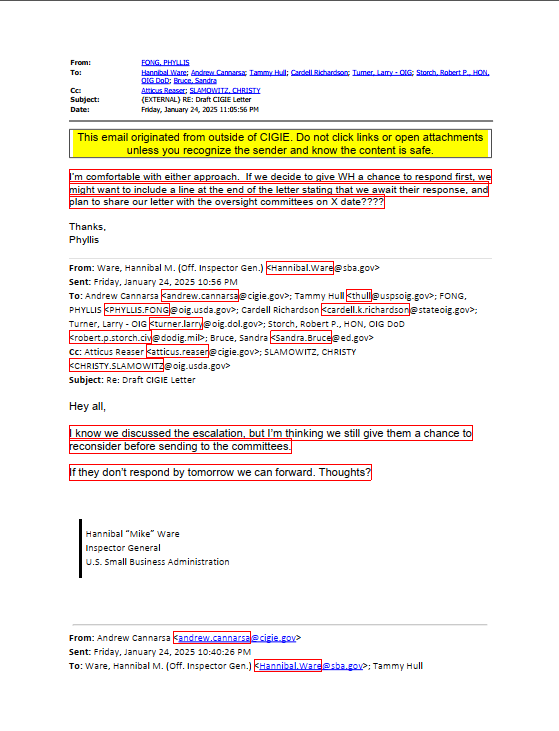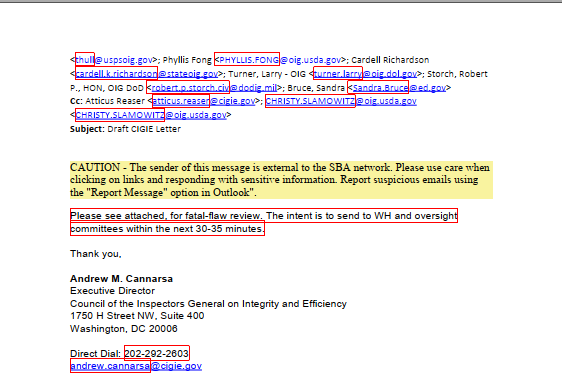
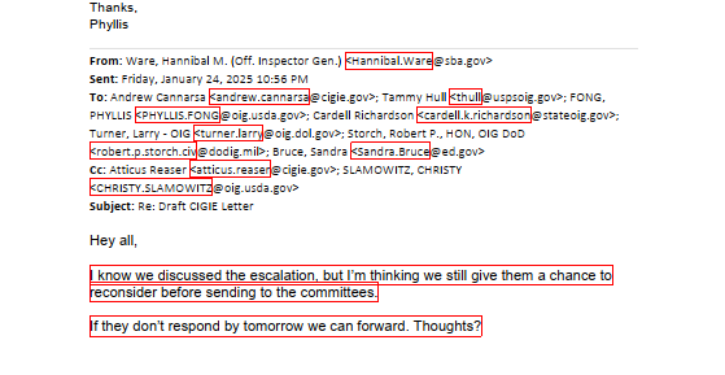
A federal agency intended to withhold most of the information it could have released under the Freedom of Information Act. But by mistake, it produced in full a document it intended to heavily redact to conceal its content. The text it intended to redact, which is underlined in red, includes even publicly-available information it should not have intended to withhold, such as the publicly-provided email address of an agency official. The agency’s intended redactions also include sentences that should be disclosed, because disclosing them won’t harm the agency, and even documents that are technically privileged are supposed to be released if disclosing them won’t harm the agency (according to the 2016 FOIA Improvement Act). So the agency shouldn’t have intended to redact these things in the first place.
On May 15, 2026, a federal agency known as the Council of the Inspectors General on Integrity and Efficiency (CIGIE) produced five documents in response to the lawsuit against it by Bader Family Foundation (BFF), over CIGIE’s failure to respond to BFF’s 2025 FOIA request for communications related to President Trump’s firing of inspectors general at 17 federal agencies. But it redacted most of those documents, such as blacking out almost all of a 6-page email from Christy Slamowitz to Inspector General Phyllis Fong (that email is posted at this link and this link).
It also intended to redact most of an email exchange between inspectors general Phyllis Fong and Hannibal Ware and Executive Director Andrew Cannarsa of CIGIE. But instead of redacting those portions, it just underlined them in red, but left them unredacted, by mistake. None of the stuff it intended to redact is highly sensitive. Many of the redactions are of agency officials’ email addresses, such as “andrew.cannarsa@cigie.gov,” which is the official agency email address Mr. Cannarsa provides the public in agency press releases to contact him. CIGIE intended to withhold these email addresses under FOIA Exemption 6. That exemption only allows agencies to withhold information about individuals in “personnel and medical files and similar files” when the disclosure of such information “would constitute a clearly unwarranted invasion of personal privacy.” Relying on that exemption is absurd, because it is not a “invasion” of Mr. Cannarsa’s “personal privacy” to disclose an agency email address he himself has previously disclosed publicly, such as in a March 20, 2024 press release.
CIGIE also intended to redact the sentences in the email discussing whether to give the White House a chance to respond to their complaint about President Trump’s firings, before sending a letter to a Congressional oversight committee. Such inter-agency deliberations arguably fall within the deliberative process privilege, which is covered by FOIA’s Exemption 5. But it is hard to see how disclosing these sentences would harm CIGIE or any other agency. Even if these sentences are privileged, the agency cannot withhold them under FOIA, unless the agency “reasonably foresees that disclosure would harm” an agency interest protected by a FOIA exemption. 5 U.S.C. § 552(a)(8)(A)(i)). Withholding these records when releasing them would do no harm defeats FOIA’s whole purpose as “a means for citizens to know ‘what their Government is up to.’”
Agencies often improperly redact most of the records sought by a FOIA request, even when the records don’t involve harmful or sensitive information. The Biden administration withheld 570 pages in their entirety out of 574 pages responsive to a FOIA request about charter schools.
Below is the January 24 email exchange between inspectors general Fong and Ware and Mr. Cannarsa, containing some ridiculous and questionable redactions. CIGIE’s lawyer asked me to return this email to him, saying that it should have been redacted before being released, and that it “appears that the redactions were selected” “but did not get applied. Would you be willing to destroy that particular document? I can ask agency counsel to resend a corrected version.” In response, I noted that the document would not be destroyed or returned, citing a 2025 decision by the D.C. Circuit Court of Appeals refusing to allow an “agency to claw back portions of records it erroneously provided in response to a FOIA request.”
Below the email exchange is an agency press release in which Mr. Cannarsa publicly discloses the very agency email address that CIGIE intended to redact in the January 24 email exchange, and actually did redact in other documents that CIGIE released on May 15, such as a heavily-redacted January 24, 2025 10:40 PM email from Mr. Cannarsa (that email is posted at this link and this link).